TechInclusion Seattle and Open Source Bridge: a diversity-in-tech twofer!

Two of my favorite conferences, in back-to-back weeks, make the Pacific Northwest the place to be for diversity and inclusion in technology this month.

Tech Inclusion Seattle - Driving an Inclusive Future

It kicks off with TechInclusion Seattle, June 14-15.  Here’s how I described TechInclusion SF late last year:

everything I look for in a conference experience: excellent content, outstanding networking, and a great mix of attendees — entrepreneurs, diversity and inclusion experts, policy people, executives, designers, engineers, marketers, investors, and hard-to-categorize people. The vibe was wonderful as well, positive with a sense of excitement, with the aid of remarkably good food and coffee.

Wayne Sutton, Melinda Briana Eppler, and the team at Change Catalysts do a great job organizing conferences, so unsurprisingly the agenda for the Seattle event features a similarly exciting mix of people: Saara Romu of the Gates Foundation, Jessica Eggert of Include Seattle, Tammarrian Rogers and Aurea Astro of Microsoft, Leslie Miley of Venture for America, Ellie Tumbuan of The Justice Collective, Andrew Mcgee of Greater, Surya Venka of and many others.   As if that’s not enough, this time the list of hard-to-categorize people includes … me!

I’ll be speaking about Diversity-friendly software and strategy on Wednesday, June 14, at 3 PM. * Just to drive home the point about how good the networking is at TechInclusion: one of the examples of diversity-friendly software I’ll be talking about is O.school, where I’m currently Tech DIVA (Technical Diversity, Inclusion, and Values Advisor).  And how did I connect with O.school?  By striking up a conversation with their CEO Andrea Barrica after a panel she was on at TechInclusion SF!

Open Source Bridge logo


Next comes Open Source Bridge, June 20-23 in Portland.  Here’s how I described it in If you enjoyed Tech Inclusion, you might also like …

Open Source Bridge (“the conference for Open Source Citizens”) is a 100% volunteer-run conference that’s been going strong since 2009 with a very strong diversity focus…. It’s more focused on development and design than some of the other conferences, with a lot of discussion of community organizing and the business of open source as well.

As always this year’s schedule looks amazing, starting with the keynotes: Nicole Sanchez on Tech Reform, Walé Ogundipé on Doing away with (bad) shibboleths (it’ll be really interesting to see how everybody pronounces the talk’s title), and Emily Gorcenski on Fake Science!  Sad! A case study of the perils of Open Data.  As a Mastodon fan, I’m also really looking forward to Federating with Trouble by the toot.cat admins; and the programming tools geek in me is very excited about my former MSR colleague Michael Ernst’s Create your own type system in 45 minutes.  It’s going to be a great conference, so if you’re in or near the software industry it’s worth checking out whether or not you’re into open source.

This year Open Source Bridge has added a track on activism – including my Thursday morning session Grassroots Activism is Hard.  Can Open Source Help?

Grassroots activists have to deal with many challenges — including the tools they’re using. Sounds like a great opportunity for open source! This session will survey progressive and transpartisan grassroots activists’ needs and today’s solutions (including techniques that work for explicitly intersectional groups), look at some existing open-source offerings and how they could evolve to better meet grassroots activists’ needs, and identify future directions that could be even more impactful.

A lot of diversity-in-tech and citizenship-in-open-source people live multiple lives, so if you’re also a grassroots activist, I’m very interested in hearing about the tools you’re using, what works, and what doesn’t.  Here’s a blog post with more information and a link to a survey.  And if you know somebody who’s involved in grassroots activism, especially with an intersectional focus, please pass the link along!

And while I’m making requests …

Open Source BridgeOpen Source Bridge is really is a grassroots all-volunteer effort, produced on a shoestring budget by the Stumptown Syndicate.   As they write in We need your help,

In order to cover the costs of producing a community conference, we rely largely on sponsorships. We haven’t been as fortunate this year in monetary recruiting and would love extra help in spreading the word about Open Source Bridge to your company or tech managers.

So those of you who are at tech companies in the Pacific Northwest, or within flying distance of Portland: as you’ll hear at my Tech Inclusion talk on Wednesday, investing in diversity-friendly software offers some significant technical advantages.  Sponsoring an event like Open Source Bridge is a great way to start connecting with the community, and giving one or more engineers or designers at your company a great chance to learn skills and make connections.  Please check out their sponsorship prospectus, and see if it makes sense for your company to sponsor!


* If you’re looking for a taste of what I’ll be talking about, you can check out the talk on Diversity-friendly software that Shireen Mitchell and I did at SXSW this March … or if wikis are your thing, here’s a session on Supporting diversity with a new approach to software Tammarrian and I did at Open Source Bridge last year.]

Lessons (so far) from Mastodon for independent social networks

Update, August 2018: This post was originally written in May 2017, and has only minor updates (fixing typos, adding a couple of additional links). Mastodon has continued to make progress, and I’m sure there are some new lessons to learn; so I added “(so far)” to the title.

April was an exciting month for Mastodon.  By the end of the month, the open-source, decentralized, social network (“Twitter without Nazis”) had grown to over 500,000 users, funding via Patreon for the lead developer and a part-time project manager, and corporate adoption.  The month had its challenges as well, of course.  14 Perspectives on a Breakthrough Month gives an overview of what happened.

Things have calmed down in May.  There’s a lot less media attention, and growth is slower.  The release process is getting more mature, with kanban boards and release candidates, and discussions in the Discourse forum as well as the Discord and Matrix chat rooms.  So now’s a great time to look at what we can learn from these experiences – for Mastodon and its future, and for other independent social networks as well.

A lot of these lessons aren’t new at all.  We’ve seen them before with Dreamwidth, Diaspora, StatusNet,  Gnu Social, Pinboard, Ello, and others. Mastodon’s a good reminder that they’re still true, so they’re worth reiterating here:

  • A lot of people want an alternative to corporate-owned ad-funded social networks.
  • Paying attention to marginalized communities is a great way to get critical mass and visibility.
  • A small team of developers can get something usable out quickly
  • There’s interest across the world, not just in the U.S.  Mastodon’s lead developer is German, the most active instances are based in Europe and Asia; France is the first government to have an instance; and initial corporate adoption came in Japan.
  • Decentralization makes things more complex

Moving on to some new lessons …

  1. Policies against racism, sexism, discrimination against gender and sexual minorities, and Nazis are extremely appealing positioning these days.  Not for everybody, of course: anti-safe-spacers, people with simplistic views of “free speech”, trolls, harassers and Nazis all have problems with it.   Still, there’s clearly a large underserved market who’s sick of the norms on Twitter, Reddit, Facebook,* and elsewhere.
  2. An explicit anti-harassment and pro-sexual-minority focus will attract a lot of people who are tired of the normalized harassment and heteronormativity on other social networks – enough to have a significant impact on the software.  Furries, LGBTQ+ people, and women have implemented the bulk of Mastodon’s functionality, and continue to help drive development going forward.
  3. A small team of developers can deliver real innovation when it comes to defenses against harassment.  Mastodon’s content warnings and instance-level blocking, while far from perfect, are both significant advances on Twitter, Facebook, Tumblr, Reddit, an earlier open-source projects.  And this lesson directly relates to the previous one: it’s LGBTQ+ people who have advocated for and implemented much of this innovative functionality
  4. However, even with a stated anti-harassment focus it can still be challenging for a network to respond well when people are actually harassed.  In decentralized networks, communications between instances whose admins have different norms about the definitions of and appropriate reactions to harassment add a level of complexity.
  5. Even with an explicit anti-harassment, anti-fascism, and anti-racism focus, people of color are likely to be marginalized if the most influential people are white.  Other patterns that are likely to occur as well (as elsewhere online):
    – cis men are likely to prioritize anti-harassment functionality lower than women and gender-diverse people
    – harassment is more likely to be directed at women, people of color, and LGBTQ+ people.
    – impacts are likely to fall most heavily on women of color, and in particular queer women of color.
  6. Rapid growth will tend to dilute a LGBTQ+ focus, unless there’s an effort to keep LGBTQ+ people centered and give them real authority.  Allie Ward’s Mourning Mastodon and Mourning What Now?!?! posts make this case in detail.
  7. The existing “fediverse” is a two-edged sword for a social network with an anti-harassment and anti-racism focus.  While the fediverse shares the goal of building an alternative to corporate sites, many fediverse sites that describe themselves as “free speech zones” (and people who prefer those sites) are likely to disagree on some core issues including the definition of harassment.
  8. Instance-level federation choices are an important tool for sites that want to create a safer environment (although need to be complemented by user-level control and other functionality).  Given the range of different attitudes towards harassment (etc.), this is likely to lead to alliances of more-closely-linked groups of sites that share values, with relatively weak connections between the groups.
  9. There’s a lot more that can be done to counter harassment, Nazism, racism, sexism, transphobia, and other hate online. Mastodon’s current functionality only scratches the surface of what’s possible – and has generally been introduced in reaction to events in the network. By contrast, Andrea Barrica’s Ignoring Online Abuse is Bad for Business. Let’s Build Safer Spaces talks about O.school’s more proactive approach, and Transforming Tech with diversity-friendly software looks at Mastodon in a broader context.

It’s early days yet for Mastodon — it’s been around for less than a year — and no doubt there’s more to learn as well. It’ll be interesting to see how the software and the community evolve over time. Stay tuned!

Thanks to Creatrix Tiara, Thursday, and others for feedback on early drafts! 

* see Mark Zuckerberg Hates Black People for a good perspective on this

Update, June 26: Here’s the tootstream from my live-tooting the toot.cat admins’ Open Source Bridge presentation Federating with the Trouble, going into more detail based on their experiences.

Mastodon: 14 perspectives on a breakthrough month

April was a big month for Mastodon, the open-source, decentralized, ad-free Twitter alternative.   As lead developer Eugen Rochko says

Twitter changed the reply system, which everybody told them they shouldn’t do, and then removed the iconic egg avatar for new users, and suddenly all of my work of telling people that one day Twitter would do something they didn’t like and they’d need a viable alternative paid off.

Yeah really!  By the end of the month, Mastodon had grown to over  500,000 users, over 1,000 instances, hundreds of contributors to the code base, and funding for a developer and project manager.  Exciting times!

Of course, rapid growth can cause challenges as well.   Can Mastodon keep its anti-harassment, pro-furry, pro-LGBTQ+, anti-Nazi focus as it grows?  What to do about content that’s acceptable by some instances but illegal elsewhere?  Is the influx of new people who don’t understand the network’s culture the start of an “Eternal April”, like Usenet’s Eternal September?*

There’s certainly a lot to learn from this last month.  Before sharing my own thoughts, I wanted to start with a bunch of other perspectives I found very useful.  These are organized mostly-chronologically, so you can get a sense of how the month played out – although I put Eugen’s April Post-Mortem at the end, to give him the last word.

@sarahjeong@mastodon.socialMastodon Is Like Twitter Without Nazis, So Why Are We Not Using It? by Sarah Jeong in Motherboard (April 4), describes her experiences in late March and early April just as things started to heat up. Her summary of the culture: “it’s really more of an LGBTQ-oriented space, one with a lot of anime avatars and a lot of furries.”   Her conclusion: “And judging by the chatter on the federated timeline, a lot of people have found a home here. Mastodon, I think, is here to stay.”

@qinaliu@mastodon.socialWhat I wish I knew before joining Mastodon, by Qina Liu on HackerNoon (April 9), uses Harry Potter gifs as part of an excellent getting-started guide. Since then, Mastodon has implemented some onboarding screens that should help new people, and introduced new functionality as well, but most of what’s here is still very relevant.

@sargoth@mastodon.socialMastodon, pineapples, social media and other unanswered questions, by Johanna Drott (April 9), captures the sense of possibilities — and the challenging questions. “What is interesting is that the sense of early 90s cyberoptimism has started to reappear. It is possible to do things again, to change things, to build things that will make a difference…. What can and ought we do to establish sustainable social norms? How do we live together without breaking one another?”

@jdp23@toot.catTransforming Tech with Diversity-Friendly Software, by me, from a presentation on April 13 at TRANSform Tech, includes a look at Mastodon’s early membership (gay communist furries, LGBTQ+ people), attention to harrasment, early significant advances over the state of the art like content warnings.

@sarahjeong@mastodon.socialFrom Witches to Dolphins, These Are the Communities That Make Mastodon Great by Sarah Jeong in Motherboard (April 14), looks at “the top five instances of Mastodon, according to me, as judged by completely meaningless criteria that I refuse to disclose”: mstdn.jp, kirakiratter.com, botsin.space, oulipo.social (which prohibits “that fifth symbol, or any variant of it, that is found in Latin script, including using “3” or homographic symbols in its spot”) and dolphin.town (“the e’s have to go somewhere”).

@dredmorbius@mastodon.cloudThe Normal Invasion (April 16–17), an epic tootstorm by @dredmorbius@mastodon.cloud, suggests that Mastodon’s initial quirkiness and welcoming to certain non-mainstream communities will inevitably be lost as the community grows.

What No One Else Has Told You About Mastodon, by Ryan Parreno (April 17), discusses the challenges of getting discovered and gentrification. “If you poke into the site now, you may not recognize it but the older users are fighting for control over the community from the newbies. Will gay-friendly Mastodon survive? Or can we build a better community in its place?”

@eileenb@mastodon.cloudIs Mastodon the new social media star, or imploding black hole?, by Eileen Brown on ZDNet (April 17), looks at the current status of Mastodon and the “fediverse”, and concludes that while Twitter and Facebook don’t need to worry about their ad revenue, Mastodon isn’t going away. “In the last seven days I have had more meaningful interactions with my few Mastodon followers there than I have over the last year with the passive followers I have on Twitter.”

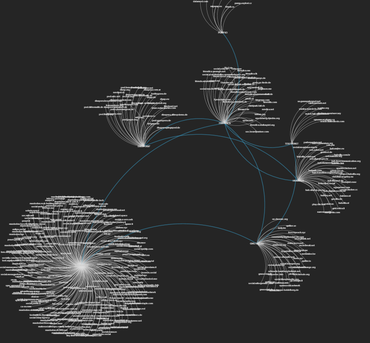
The graph of the fediverse — Liaizon Wakest. Mastodon is the lower left structure.

@amaelle_g@mastdn.frMastodon : un autre Twitter est possible (in French) by Amaelle Guiton in Libération, on April 19 looks at the reality, challenges, and possibilities as of mid-April, with excellent observations from Cthulhu 2017, suggesting that it’s off to a more promising start than other alternative social networks like Diaspora*, and Corentin on communities around values.

@u2764@icosahedron.websiteMourning Mastodon and Mourning What Now? by Allie Hart (April 22–23) look in more depth at the power structure and ways in which queer people are increasingly being marginalized (as well as other diversity isssues). “Had Mastodon given queer contributors the ability to make executive decisions regarding the project, the community could have reached a place where it was no longer in peril.”

Tomio Shimizupixivのマストドン参入の理由と可能性についてPawooプロダクトマネージャーが語る — ログミー (Pixiv’s Pawoo Person Speaks) (in Japanese), on Logmi (April 25), a transcription of a talk by Tomio Shimizu of Pawoo.net, discusses what Pixiv is planning on doing with its Mastodon integration. Matthew Skala’s Mastodon WTF Timeline (in English) has some useful background on this.

@NinahMarie@social.tchncs.deThe Bits and Bytes of Mastodon (in Dutch), by Ninah Marie on De Weg Naar, (April 25), looks at the network as sparking a “giant international multicultural chatbox”, has a great set tips and tricks, and in a postscript talks about how professionals might use Mastodon.

Laure Lucchesi >Laure Lucchesi : “Nous voulons tenter l’aventure du réseau social Mastodon”(in French), Acteurs publics (April 28): an interview with the director of the French government agency Etalab discssing why they’ve set up a Mastodon instance for French government employees.

@Gargron@mastodon.socialApril Post-Mortem, by Mastodon lead developer Eugen Rochko (April 25) looks at the month and the current state of Mastodon.

There was plenty of other good stuff written as well, but these should be enough to get you started.

Coming soon: Lessons from #EternalApril


* I first heard the term “Eternal April” from Roza Shanina.  Kit Redgrave and gravity conscious orb both used it early the month; and no doubt others have as well.

Grassroots activism and open source – coming soon, at Open Source Bridge!

Open Source Bridge logow00t! I’m delighted to announce that my proposal for a Open Source Bridge session on Grassroots activism is hard. Can open source help? has been accepted! Thanks to Aditi Juneja, Harry Waisbren, and Chris Benson for the feedback on earlier versions.

Here’s the abstract:

Grassroots activists have to deal with many challenges — including the tools they’re using. Sounds like a great opportunity for open source! This session will survey progressive and transpartisan grassroots activists’ needs and today’s solutions (including techniques that work for explicitly intersectional groups), look at some existing open-source offerings and how they could evolve to better meet grassroots activists’ needs, and identify future directions that could be even more impactful.

You can read the whole proposal here.

Open Source Bridge is “the conference for open source citizens”, and one one of my favorite conferences. There are lots of other great proposals  (I’m especially looking forward to the one on Federating with Trouble by the toot.cat admins),  so by all means check out, if you’re interested in open source software or diversity in technology. The conference is from June 20–23; session my tentatively scheduled for Thursday, June 22 at 10 a.m..

Between now and then, I’ll be surveying the landscape today — and documenting details on the wiki (an approach that worked extremely well for the session Tammarrian Rogers and I did last year on Supporting Diversity with a New Approach to Software). For example:

  • Describe grassroots activist groups’ typical needs
  • Look at the kinds of solutions in use today
  • Highlight techniques from projects like Resistance Manual that take an explicitly intersectional focus
  • Look at some existing open-source offerings, how they can help today, and how they could evolve to better meet grassroots activists’ needs

If you’ve got any thoughts on those, please share — here, on Twitter, or on Mastodon, where I’m @jdp23@toot.cat!

Learning from Hacker News’ “Detox” Experiment

Political Detox Week – No politics on HN for one week. Like everyone else, HN has been on a political binge lately. As an experiment, we're going to try something new and have a cleanse. Starting today, it's Political Detox Week on HN. For one week, political stories are off-topic. Please flag them. Please also flag political threads on non-political stories. For our part, we'll kill such stories and threads when we see them. Then we'll watch together to see what happens

The guys from YCombinator (YC) who run the popular Hacker News (HN) discussion site have always been wary of allowing political discussions.  YC’s original CEO Paul, current CEO Sam, lead moderator Dan, and key influencers on the site like Thomas argue that political topics inevitably lead to acrimonious and low-quality discussions.  Over the years, HN has done a lot to cut down on political discussion.*

Of course, politics aren’t completely banned.**  Many aspects of technology and entrepreneurship are inherently political.  Just like everywhere else online, these discussions got more heated over the course of 2016.  By October, when part-time YC partner Peter gave $1.25 million to Trump’s campaign and Paul claimed on Twitter that few had done more than Sam to help defeat him, it was hard to avoid politics on HN.

The frequency and intensity of political discussions continued to increased after the election.  And the tone became less civil; mirroring the trends across the US, more and more people on HN shared opinions that others found sexist, racist, anti-immigrant, anti-Muslim, etc. etc. etc.

So in early December, Dan (aka dang) announced an experiment: a week-long “political detox”, where political stories were banned. Some people weren’t quite sure what this meant, so Dan clarified:

The main concern here is pure politics: the conflicts around party, ideology, nation, race, gender, class, and religion that get people hot and turn into flamewars on the internet.

“Of course it’s delusional”

nneonneo: Many of the top-level comments here are against this move. I, on the other hand, would like to express my strong support for this move. Political discourse is antithetical to rational, intelligent discussion.

Unsurprisingly, the announcement got a lot of support.  nneonneo’s top-ranked comment is a good example.

There was also a lot of pushback.   Nitasha Tiku’s Tech Commenters Cry Foul After Popular Silicon Valley Forum Bans Politics on  Buzzfeed has some great quotes from Zoe Quinn, Maciej Ceglowski of Pinboard, Danilo Campos of HNWatch, Matthew Garrett, and others.  For example:

“Silicon Valley routinely makes impacts on race, gender and class—but discussions of those things is forbidden on Hacker News for a week 🤔”

Danilo, on Twitter


And here’s an excerpt from the HN discussion

minimuffins: The idea that we can carve out a space that exists outside of politics and ideology is delusional.

dang (lead moderator): Of course it’s delusional. The concepts can’t be defined to begin with, nor can they be separated in any consistent way. And still we have to moderate this site.

jdp23 (me!): Perhaps grounding your moderation policies around concepts you know are undefined and inseparable isn’t the best basis for moderating the site.

dang: It’s the best basis for moderating the site because the alternative is impossible.

What could possibly go wrong?


“Dear @ycombinator: this is fucked up”

Matthew Garrett, on Twitter

Looking at the bright side, the experiment did bring a rare moment of unity.  People who thought this was a bad policy and people who approved of it joined together in a flagging frenzy.

ubernostrum flagged and commented every story that had political aspects – and got temporarily banned as a result.

idlewords, minimaxir and I each submitted a story about something that could have a major impact on the tech industry.  It got killed each time.

William Gibson’s New York Times op-ed about privacy met the same fate.

So did Georgia Wells’ Wall Street Journal article about how tech companies aren’t meeting their own goals for improving diversity.

Nobody was immune.


“YCombinator’s Winter Reading List just got flagged off their own discussion site’s front page for political content.”

Pinboard, on Twitter

What YC learned from the experiment

The experiment lasted two days.  Dan quietly announced its end in a comment on a discussion about regulation.

Although it hasn't been a week, I think we've learned as much from it as we're going to, so it can be over now. Among what we learned is that it's impossible to define 'politics' with any consensus because that question is itself highly political, and that HN is at its best when it can meander through all the (intellectually) interesting things, some of which inevitably have political dimensions. … In other words, the existing guidelines have it about right

I asked Dan what else they had learned.  His reply

The main thing we learned is that a change like that won’t solve HN’s civility problem, which was the big question we had. But we learned other interesting things too, like that a week is too long for trying out an idea like this. Also, if we say we’re trying out an idea briefly, some people think we mean permanently. Communication on the internet is hard.

A thread asking folks on HN what they had learned didn’t get a lot of traction, but the handful of replies were interesting.  For example, here’s what wingerlang said:

I didn’t even know it ended. *** I read the initial post but since then forgot about it and HN seemed like usual business.

What else can we learn?


“If your website’s full of assholes, it’s your fault”

Anil Dash (2011)

Dan’s main learnings were actually pretty obvious even before the experiment.  adrienne was one of many people on HN who predicted it:

I mean, fundamentally my position is the same as Anil Dash’s… Trying to separate out “political” from “apolitical” topics is not going to solve the fucking problem. Being better moderators and not letting people be tremendous bigots even if they’re ‘civil’ are the ways to fix the problem.

Indeed.

Still, it seems to me that there are some other very interesting things to learn from the experiment.  Before I share my thoughts, though, I wanted to once again ask for other perspectives.

What did you learn?


* For example, the ranking algorithm penalizes stories about politics, and Paul repeatedly tweaked the ranking algorithm to penalize specific topics like the TSA or the NSA.  The flagging algorithm lets a relatively-small number of people remove a post from active discussion.  The “controversy detector” shuts down heated discussions; so when a contentious story makes it to the front page, people pile in with lots of strongly-words posts and it quickly drops to page 3 where it’s much harder to find it.   Ken Shirriff’s 2013 article How Hacker News ranking really works: scoring, controversy, and penalties and the accompanying HN discussion have more details

** In fact, from time to time YC actively encourages talking about politics, like when they joined the fight against the anti-internet SOPA bill and it was suddenly a perfectly acceptable topic.

*** wingerlang wasn’t the only one that didn’t even know the ban had ended.  For some reason the moderators never made the announcement as a separate thread.  Several days later, posts were still being killed for being political – including discussions about Russia potentially hacking the US election, which certainly seem on-topic for Hacker News.  Apparently not.

It’s time to double down on diversity and inclusion

lights-and-candlesTwo days after the election, New Tech Northwest had a diversity-in-tech event in Bellevue. To be honest, I wasn’t in the mood. Networking’s an effort for me even in the best of times, and this is most definitely not the best of times. But then again it seemed better than spending more time being depressed about the results, so I decided to go.

I wasn’t the only one who felt that way.  Almost all the speakers talked about the election, sharing their shock and sadness, saying things like “I didn’t know if I would be up to coming tonight”.  It came up in a lot of the casual discussions with other attendees as well.  Several people told me it was the first time they had been out of their house since Tuesday.

By the end of the event, most of us were in a noticeably better frame of mind.   Some of it was just the experience of being in a diverse crowd of interesting people, talking about something we’re all passionate about  Most of all, though, it was the very first speaker who changed the mood – for me, and I think for a lot of others as well.

How to react?

Cynthia Tee, Executive Director of Ada Developers Academy started her talk off by saying “Yes, I’m going to go there,” and shared how the morning after the election she spoke with a diverse group of women, non-binary, and gender fluid students. What message to send them?


“It’s time to double down on diversity and inclusion.”

Cynthia Tee


Yeah, really!

Cynthia’s Preparing for the Years Ahead on the Ada Developer Academy tumblr goes into a lot more detail about what she means. Here’s an excerpt:

What happened last night and today makes us more defiant, and determined to double down on the change we’re after. We each look inward and ask ourselves what we can do individually – and as a team – to combat oppression, speak up against it, and support other organizations who champion equity…. There is no place for neutrality, complacency, or silence. As a community, we want to move through this historical moment with solidarity, agency, activism, and pride.

Indeed.

A few days later, here’s what EricaJoy said in her post After:


It is time for leaders in the the tech industry to double down on their Diversity and Inclusion efforts.

EricaJoy

Hey wait a second, I’m noticing a pattern here!

Reasons to double down


“Progress is not inevitable, it requires our intervention.”

Malkia Cyril, at Fusion Magazine’s Real Future Fair

In the aftermath of the Trumpocalypse, there are a lot of reasons to double down on diversity and inclusion.   The most important: a lot of blacks, Latinxs, women, Muslims, LGBTQs, immigrants, people with disabilities, and other marginalized groups are being targeted and need our support right now.  Several of the links in the reading list have suggestions about how you can help.

And let’s face it, the lack of diversity in the leadership and engineering teams of companies like Facebook and Twitter helped contribute to where we are today.  The environment they’ve created empowers harassers and trolls; magnifies hate speech and false news; pushes people into filter bubbles and echo chambers; optimizes for psychological manipulation and radicalization; and tracks people’s preferences, locations, associations, and personal data without protections against authoritarian governments.

Now the same kinds of non-diverse teams at non-diverse companies are building VR worlds with no defense against sexual assault and algorithms that embed historical biases in the code at the expense of marginalized groups.   Is this really what we want?

The world’s ready for a new approach to software, one that embraces differences and sees diversity as a strength.

Diverse teams are more creative and better at problem solving.  Yes, it can be challenging to get people from different backgrounds to communicate effectively and work together well;  but as I was pointing out just last week, we know a lot about how to create inclusive environments.   The diversity-in-technology community can be a key part of a multiracial, multi-cultural, international, transpartisan alliance of people who want to work together to change things – in tech, and more broadly.

And finally, while the short-term priority is to limit the damage from this election, here in the US and around the world, we’re not just trying to get back to the situation we had before.  Our goal is to build the kind of world we want to live in.  For me – and hopefully for you as well – diversity and inclusion are at the center of the future we’re creating.

Postscript: additional reading, ripped from today’s headlines

Here’s a handful of links from the last week or so that I’ve found especially valuable.  Read and share!