7 Organizations to Support on #GivingTuesday

Giving Tuesday logo

The idea behind #GivingTuesday is a great one: leverage the buzz of Black Friday and Cyber Monday to spark interest on social media and encourage people to donate. It makes a lot of sense to complement the traditional end-of-the-year fundraising with a timely event when people are in the holiday spirit but haven’t yet blown their budget on Christmas gifts.

So here’s a short list of seven organizations that I’ll be supporting this year. Your mileage may vary, of course; there are many many other non-profit organizations doing outstanding work. But as you’re thinking about your giving, on #GivingTuesday and throughout the rest of the year, please keep these groups in mind!

The Center for Media Justice is a nationally recognized organizing hub representing the media policy interests and building the cultural leadership of hundreds of social justice groups across the United States — and one of the most important civil liberties organizations in the country. During this time of rising hate, online and off, it’s especially important to fuel the fight for the digital rights of those most vulnerable across the country. Donate here. Or, if you prefer to donate via Facebook, my friend Shahid Buttar (who’s on their board) has a Facebook fundraiser here.


A flaming star - the Gender Justice League logoThe Gender Justice League fights gender and sexuality oppression in Washingon State and  creates community where trans people live lives safely, true to themselves, and free from discrimination.  As well as Trans Pride Seattle, they engage in 1-1 and community advocacy, building, growing, training, and mobilizing the Trans* and Gender Non-Conforming communities to address the systemic oppression the communities face.  Gender Justice League founder Danni Askini is currently seeking asylum in Sweden after threats from white supremacists and persecution from the US State Department, so it’s a critical time to support them.  Donate here.


The Northwest Immigrant Rights Project keeps families together, protects people from violence, and takes injustice to court.  As well as high-impact litigation, including fighting racial profiling by border patrol officials in the Olympic Peninsula and securing the right to an attorney for mentally ill immigrants facing deportation, provide free legal services work, they support survivors of domestic violence, and do a huge amount of community education.  Donate here.
 

Four Directions had a huge impact this fall with their work helping provide IDs to Native Americans in North Dakota this fall — leading to turnout increase of over 100% in some areas, and an upset victory over the state legislator who had authored the voter suppression law. They also did key work in several other states, focusing on full enfranchisement as a crucial way to navigate a stronger future for Native communities .Donate here.

 

Hollaback is a global movement to end harassment, and builds safe, inclusive public spaces by transforming the culture that perpetuates discrimination and violence. Projects include the Heartmob platform for dealing with online harassment, bystander intervention trainings, a leadership program, that trains young people to launch their own Hollaback! chapters locally,and The People’s SupperDonate here.


SWOP Seattle is the local chapter of the Sex Workers Outreach Project (SWOP-USA), a national social justice network of organizations dedicated to the fundamental human rights of sex workers and their communities, focusing on ending violence and stigma through education and advocacy.   This has been a brutal year for sex workers; as expected, the passage of the FOSTA/SESTA bill earlier this year has devastated many sex workers’ income and forced them into much more hazardous situations.   Donate here.

BMMA: Black Mamas Matter Alliance logo

Black Mamas Matter Alliance is a Black women-led cross-sectoral alliance that centers Black mamas to advocate, drive research, build power, and shift culture for Black maternal health, rights, and justice. Grounded in the human rights, reproductive justice, and birth justice frameworks, BMMA provides technical assistance, trainings, and capacity building for grassroots organizations, maternity care service providers, academia, and the public health industry.  The first ever Black Maternal Awareness week they sponsored in April highlighted the shameful tragedy of preventable maternal deaths of women during childbirth – a burden disproportionally experienced by Black women.     Donate here.

Mobilizing to help fight voter suppression

People carrying signs saying "Voing Rights are Human Rights"


With only ten days before Election Day, it’s clear that a lot of races will come down to whose votes get counted.   New ID requirements for Native Americans, moving the only polling place in Dodge City to the outskirts of town (a mile away from any public transportation) and then sending new voters the wrong address, voting machines changing votes in Texas, voter purges, “pending” lists … hey wait a second, I’m noticing a pattern here.

Voter suppression – largely directed against Black, Native American, Latinx, and student voters – has long been one of the major tools the right wing uses to stay in power in the US.  2018 is no exception.  The Texas, Florida, North Dakota, Nevada, and Tennessee Senate races may well be decided by voter suppression; ditto for the Georgia, Kansas, Wisconsin, and Florida Governor races, and hundreds of other federal, state and local elections.

Fortuantely, all across the country, people are fighting back – with legal challenges, new IDs issued by Native American tribes, phone and text hotlines backed by pro bono lawyers, educating people about their rights, and dozens of other ways.  A lot of the people and organizations on the front lines have been doing this for years and know what tactics work.

Here’s three things you can do to help.

Volunteer

The non-partisan Election Protection Coalition makes it easy to sign up as a poll monitor – and if you ‘re a lawyer, paralegal, law student or other legal professional, you can help with their voter assistance call site and field programs.

Many local groups also offer volunteering opportunities; try doing a web search for the name of your city or state and “voting rights organizations”.

Help get the word out

Voter Intimidation is illegal and unlikel. But this is what it looks like - and what you can report.Many voter suppression techniques rely on intentionally confusing voters.  One way that everybody can help counter this is to increase the chances that voters being targeted for suppression know their rights and have access to accurate information.  For example:

More generally, if you hang out on Facebook or Twitter, you can also help by liking and commenting on posts and tweets with useful information about voting rights.  The engagement a post or tweet gets, the more visibility the platforms give it.  While the effect of just a single like or comment is relatively small, a few dozen people working together can really have an impact.

And if you’ve got friends and acquiantances who care about the November election, try to get them involved as well.   Share some of the links here (or even this whole article) with them and ask them to help.

Donate

Most of the groups involved here are grassroots organizations on a tiny budget; I’ve got a short list below.  If you’re looking to contribute to a potential “Blue Wave” in the election, this is one of the most leveraged places to put your money.

There are a lot of excellent organizations working on this issue around the country … so many that it can be overwhelming.  So here’s a short list of three well-respected organizations to use as a starting point.

Four Directions logoFour Directions works with Tribes in Nevada, Arizona, Montana, North Carolina, Minnesota, North Dakota, and South Dakota and focuses on full enfranchisement as a crucial way to navigate a stronger future for Native communities.  Donate here.


Lawyers' Committee for Civil Rights Under LawThe Lawyer’s Committee for Civil Rights Under Law has long been one of the leaders in the fight for voting rights.  As well as running the 866-OUR-VOTE hotline, they also get involved in legal issues before and after the election – for example, challenging Gwinnett County’s rejection of mailed-in ballots.  Donate here.

LDF: Defend, Educate, EmpowerThe NAACP’s Legal Defense Fund has lawyers and volunteers on the ground in Texas, Georgia, Alabama, South Carolina, Louisiana, Missouri, and Florida.  One high-profile case they’re involved in is working with students at Prairie View A&M who are suing Waller County in TexasDonate here.


Spread the VoteSpread the vote helps eligible voters get government-issued photo IDs, responding to one of the most severe forms of voter suppression, and has chapters in Georgia, Tennessee, Florida, Virginia and Texas.   Donate here.


This isn’t by any means an exhaustive list.  There are plenty of other organizations that do great work here and are also well worth supporting – look for ones in your local area or involved in races you especially care about.  If there’s an organization you recommend (or are part of!), please share information and a link in the replies!


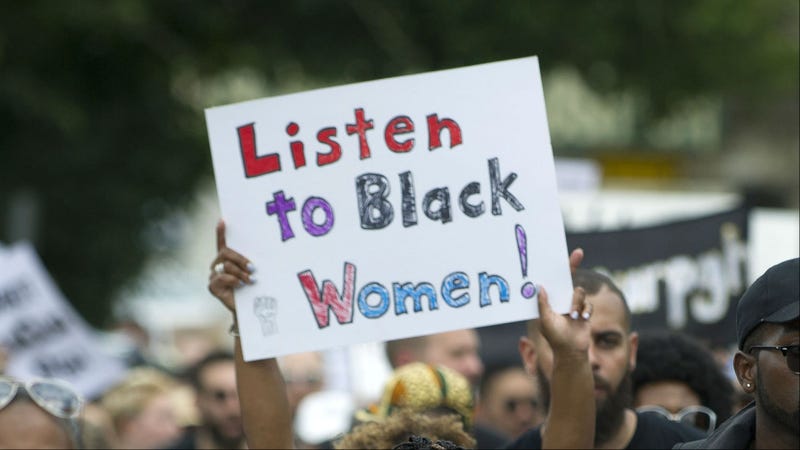
Listen to Black Women!

Sign saying

Hey wait a second, I’m noticing a pattern here …

The Moment by Shireen Mitchell (aka @digitalsista) are both well worth listening to.   Shireen’s been calling attention to this for a while, and this Moment weaves together various threads and articles.  Nicole’s one of the leading voices for intersectional diversity, inclusion, justice, and equaity in the software industry, and the replies include her perspective as a Latinx woman as to why listening to black women is so important in this context. Safiya Umoya Noble’s recent Wired article Social Inequality Will Not Be Solved By an App is also well worth listening to, as is her outstanding book Algorithms of Oppression.

But what I especially want to highlight in this post is the overall theme.

Listen to Black women.

It’s good advice in the workplace.  It’s good advice professionally – collaborating with (and listening to) Shireen, Tammarrian Rogers, and Lynn Cyrin helped me raise my game and took our work on diversity-friendly software to a much higher level.  It’s good advice in politics and activism.  It’s good advice for protecting democracy.  It’s good advice in general.

Of course, I’m far from the first person to say this.  But a lot of white people, and a lot of guys, still act like they haven’t gotten the memo.

Fortunately, this is one of those rare pieces of advice that it’s very easy to act on.  Start by looking at your own behavior: are you hearing Black women’s voices?  Are you really listening to them?

Then get to work on to your friends, family, and colleagues.  Encourage them to listen; amplify Black women’s voices to make it easier for them.

It’s really not that hard.

Listen to Black women.


Image credit: Jeff Swensen, Getty Images, via Kiratiana Freelon’s March for Black Women Organizers Want to Put Our Issues Front and Center During March for Racial Justice on The Root

Intersectionality: definitions, videos, and links

“Intersectionality” is a concept that a lot of people – including me, when I first heard it – find challenging to really understand.

The definition is actually fairly straightforward.  Merriam-Webster has a very pithy version:

when forms of discrimination combine, overlap, and intersect

Here’s what Wikipedia says:

Intersectionality is a term coined by American civil rights advocate Kimberlé Williams Crenshaw to describe overlapping or intersecting social identities and related systems of oppression, domination, or discrimination. Intersectionality is the idea that multiple identities intersect to create a whole that is different from the component identities.

And M-W’s Words We’re Watching page has a short history of the word

The term was coined by legal scholar Kimberlé Crenshaw in a 1989 essay that asserts that antidiscrimination law, feminist theory, and antiracist politics all fail to address the experiences of black women because of how they each focus on only a single factor. Crenshaw writes that “[b]ecause the intersectional experience is greater than the sum of racism and sexism, any analysis that does not take intersectionality into account cannot sufficiently address the particular manner in which Black women are subordinated.”

Though originally applied only to the ways that sexism and racism combine and overlap, intersectionality has come to include other forms of discrimination as well, such as those based on class, sexuality, and ability.

Indeed.

Still, even once you know the definition, the concept itself is subtle and complex, and the implications are very far-ranging.  If you want to understand it better, you really need to dig into it.  So here are some videos and links.

There’s lots of other good stuff out there as well … if you have some favorite links, feel free to share them!

A stick figure, with arrows pointing to it saying race, education, sexuality, ability, age, gender, ethnicity, culture, language, and class
Image source: All Booked Up

Intersectional Inclusion: Perspectives from the Resistance Manual

Resistance Manual - A Project by Stay Woke

One of the topics in my upcoming Open Source Bridge presentation Grassroots Activism is Hard.  Can Open Source Help? is

Highlight techniques from projects like Resistance Manual that take an explicitly intersectional focus

You can see the work-in-progress list of techniques on the OSBridge wiki.  This post focuses specifically on the Resistance Manual.

Continue reading Intersectional Inclusion: Perspectives from the Resistance Manual

Learning from Hacker News’ “Detox” Experiment

Political Detox Week – No politics on HN for one week. Like everyone else, HN has been on a political binge lately. As an experiment, we're going to try something new and have a cleanse. Starting today, it's Political Detox Week on HN. For one week, political stories are off-topic. Please flag them. Please also flag political threads on non-political stories. For our part, we'll kill such stories and threads when we see them. Then we'll watch together to see what happens

The guys from YCombinator (YC) who run the popular Hacker News (HN) discussion site have always been wary of allowing political discussions.  YC’s original CEO Paul, current CEO Sam, lead moderator Dan, and key influencers on the site like Thomas argue that political topics inevitably lead to acrimonious and low-quality discussions.  Over the years, HN has done a lot to cut down on political discussion.*

Of course, politics aren’t completely banned.**  Many aspects of technology and entrepreneurship are inherently political.  Just like everywhere else online, these discussions got more heated over the course of 2016.  By October, when part-time YC partner Peter gave $1.25 million to Trump’s campaign and Paul claimed on Twitter that few had done more than Sam to help defeat him, it was hard to avoid politics on HN.

The frequency and intensity of political discussions continued to increased after the election.  And the tone became less civil; mirroring the trends across the US, more and more people on HN shared opinions that others found sexist, racist, anti-immigrant, anti-Muslim, etc. etc. etc.

So in early December, Dan (aka dang) announced an experiment: a week-long “political detox”, where political stories were banned. Some people weren’t quite sure what this meant, so Dan clarified:

The main concern here is pure politics: the conflicts around party, ideology, nation, race, gender, class, and religion that get people hot and turn into flamewars on the internet.

“Of course it’s delusional”

nneonneo: Many of the top-level comments here are against this move. I, on the other hand, would like to express my strong support for this move. Political discourse is antithetical to rational, intelligent discussion.

Unsurprisingly, the announcement got a lot of support.  nneonneo’s top-ranked comment is a good example.

There was also a lot of pushback.   Nitasha Tiku’s Tech Commenters Cry Foul After Popular Silicon Valley Forum Bans Politics on  Buzzfeed has some great quotes from Zoe Quinn, Maciej Ceglowski of Pinboard, Danilo Campos of HNWatch, Matthew Garrett, and others.  For example:

“Silicon Valley routinely makes impacts on race, gender and class—but discussions of those things is forbidden on Hacker News for a week 🤔”

Danilo, on Twitter


And here’s an excerpt from the HN discussion

minimuffins: The idea that we can carve out a space that exists outside of politics and ideology is delusional.

dang (lead moderator): Of course it’s delusional. The concepts can’t be defined to begin with, nor can they be separated in any consistent way. And still we have to moderate this site.

jdp23 (me!): Perhaps grounding your moderation policies around concepts you know are undefined and inseparable isn’t the best basis for moderating the site.

dang: It’s the best basis for moderating the site because the alternative is impossible.

What could possibly go wrong?


“Dear @ycombinator: this is fucked up”

Matthew Garrett, on Twitter

Looking at the bright side, the experiment did bring a rare moment of unity.  People who thought this was a bad policy and people who approved of it joined together in a flagging frenzy.

ubernostrum flagged and commented every story that had political aspects – and got temporarily banned as a result.

idlewords, minimaxir and I each submitted a story about something that could have a major impact on the tech industry.  It got killed each time.

William Gibson’s New York Times op-ed about privacy met the same fate.

So did Georgia Wells’ Wall Street Journal article about how tech companies aren’t meeting their own goals for improving diversity.

Nobody was immune.


“YCombinator’s Winter Reading List just got flagged off their own discussion site’s front page for political content.”

Pinboard, on Twitter

What YC learned from the experiment

The experiment lasted two days.  Dan quietly announced its end in a comment on a discussion about regulation.

Although it hasn't been a week, I think we've learned as much from it as we're going to, so it can be over now. Among what we learned is that it's impossible to define 'politics' with any consensus because that question is itself highly political, and that HN is at its best when it can meander through all the (intellectually) interesting things, some of which inevitably have political dimensions. … In other words, the existing guidelines have it about right

I asked Dan what else they had learned.  His reply

The main thing we learned is that a change like that won’t solve HN’s civility problem, which was the big question we had. But we learned other interesting things too, like that a week is too long for trying out an idea like this. Also, if we say we’re trying out an idea briefly, some people think we mean permanently. Communication on the internet is hard.

A thread asking folks on HN what they had learned didn’t get a lot of traction, but the handful of replies were interesting.  For example, here’s what wingerlang said:

I didn’t even know it ended. *** I read the initial post but since then forgot about it and HN seemed like usual business.

What else can we learn?


“If your website’s full of assholes, it’s your fault”

Anil Dash (2011)

Dan’s main learnings were actually pretty obvious even before the experiment.  adrienne was one of many people on HN who predicted it:

I mean, fundamentally my position is the same as Anil Dash’s… Trying to separate out “political” from “apolitical” topics is not going to solve the fucking problem. Being better moderators and not letting people be tremendous bigots even if they’re ‘civil’ are the ways to fix the problem.

Indeed.

Still, it seems to me that there are some other very interesting things to learn from the experiment.  Before I share my thoughts, though, I wanted to once again ask for other perspectives.

What did you learn?


* For example, the ranking algorithm penalizes stories about politics, and Paul repeatedly tweaked the ranking algorithm to penalize specific topics like the TSA or the NSA.  The flagging algorithm lets a relatively-small number of people remove a post from active discussion.  The “controversy detector” shuts down heated discussions; so when a contentious story makes it to the front page, people pile in with lots of strongly-words posts and it quickly drops to page 3 where it’s much harder to find it.   Ken Shirriff’s 2013 article How Hacker News ranking really works: scoring, controversy, and penalties and the accompanying HN discussion have more details

** In fact, from time to time YC actively encourages talking about politics, like when they joined the fight against the anti-internet SOPA bill and it was suddenly a perfectly acceptable topic.

*** wingerlang wasn’t the only one that didn’t even know the ban had ended.  For some reason the moderators never made the announcement as a separate thread.  Several days later, posts were still being killed for being political – including discussions about Russia potentially hacking the US election, which certainly seem on-topic for Hacker News.  Apparently not.